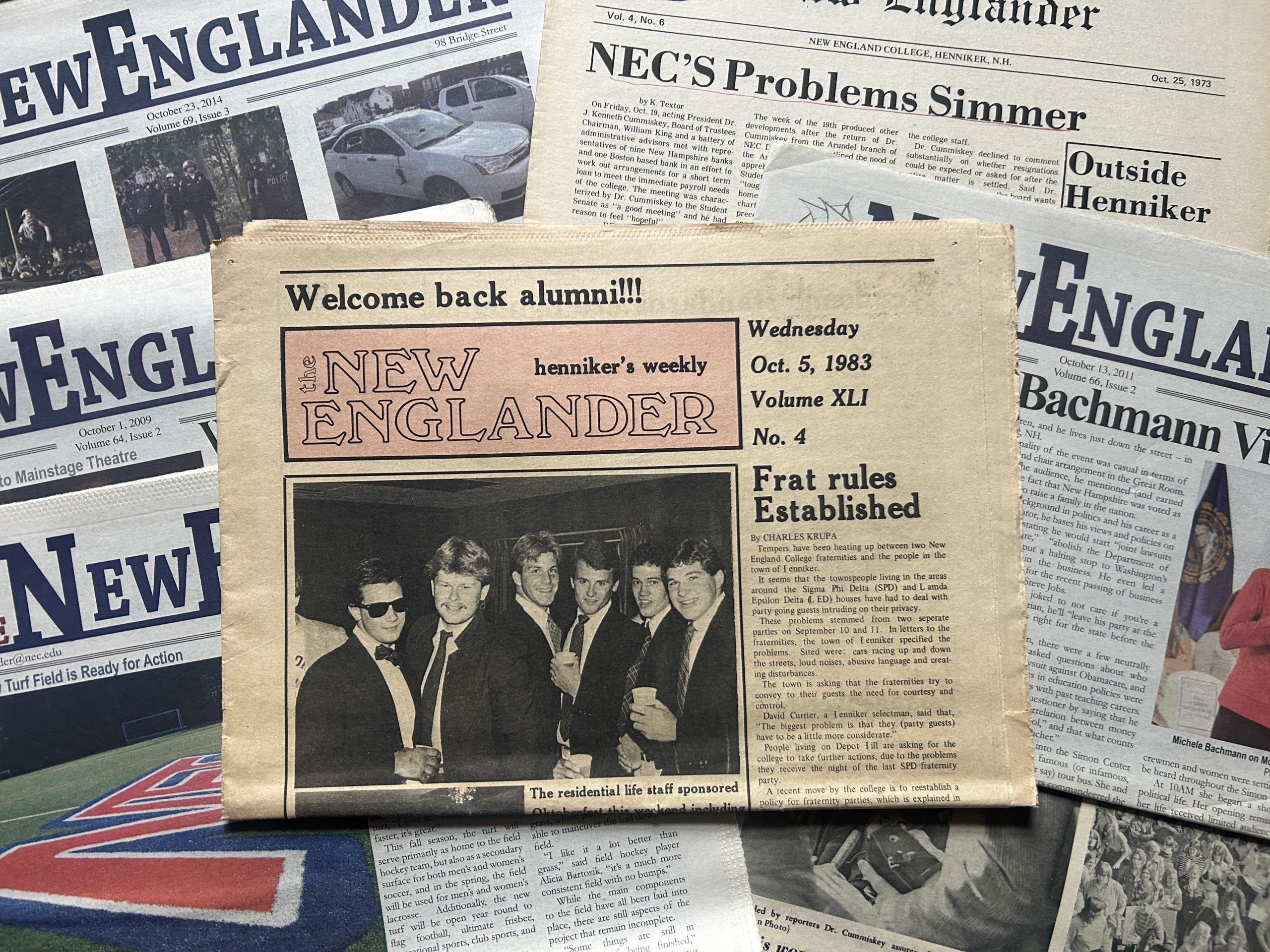

In this series, Tess Anderson looks back on news events impacting the NEC community and provides an update.
Marijuana Legalization
In 2009, The NewEnglander reported on ongoing protests that were occurring in Keene. The protesters were gathering at 4:20pm, calling for the legalization of marijuana.
The NewEnglander reported that the protesters said, “They will continue to congregate at Central Square until marijuana laws are reformed.”
In the 16 years since The New Englander reported on the issue, New Hampshire still has not legalized marijuana, whereas all other New England states have legalized the drug.
In 2013, New Hampshire allowed marijuana use for medical purposes and decriminalized the drug in 2017, meaning that “there is no prison time or criminal record for first-time possession of a small amount for personal use.”
Protests for the legalization of marijuana seem to have slowed down in recent years in Keene, but just because there hasn’t been much noise about the desire for the legalization of weed by New Hampshire citizens does not mean that some legislators and citizens are giving up on the issue.

There are continuous propositions and bills proposed with the goal to increase the ability for New Hampshirites to acquire marijuana, but most have been killed at the legislature level. All recent attempts for a bill to legalize marijuana have been killed, and most other bills surrounding marijuana have also been killed. These recent bills like HB 75, 53, 196, and 198, have all passed in the House but died in the Senate.
Governor Kelly Ayotte has explicitly opposed the legalization of marijuana and would likely veto any bills that involve increasing the access to marijuana if the bills ever make it to her office. Ayotte has said on that matter that she is concerned about the quality of life and “the impact on the mental health of youth, and also they can’t measure it when it comes to road safety.”
Despite the governor’s opposition to legalization, a poll from April of this year found that 70% of New Hampshire citizens support the legalization of marijuana for recreational use.
1987 Spring Weekend Cancelled
For NEC students, River Day is a much-beloved tradition that has seen dramatic changes throughout the history of NEC. Before the existence of River Day, a weekend full of drinking, partying, and participating in raft races on the Contoocook River called “Spring Weekend” was cancelled in 1987. The students reported that this cancellation left them frustrated. Their weekend off before the stress of finals and their opportunity to spend time with friends before summer break was canceled.

The former dean of students, faculty, and Henniker townspeople weighed in on why the weekend was cancelled. For one, many students were no longer able to participate in the drinking-related activities after the drinking age was changed from 18 to 21 in 1985. NEC alums were reportedly coming to NEC and would “party their brains out” which the school couldn’t control. Henniker townspeople commented that spring weekend led to littering and loud noise, and faculty felt that spring weekend was “too close to finals and didn’t give students enough time to get into the swing of students.”
At the end of the reported story, the dean of students told The NewEnglander that they were planning to revamp spring weekend and establish new activities for students.
Gay Marriage
By 2011, only six states in the U.S. had legalized gay marriage when The NewEnglander wrote an op-ed on the issue. Those six states included Massachusetts, Connecticut, Iowa, Vermont, New Hampshire, and New York. It wasn’t until 2015 that gay marriage was legalized in all 50 states with the Obergefell v. Hodges Supreme Court case.
In the past few months, the Obergefell v. Hodges case has been in the minds of millions of Americans, as a recent attempt by Kim Davis has asked the Supreme Court to rethink the issue.

Just two months after the supreme court ruling in 2015, Kim Davis, a Kentucky county clerk, garnered significant publicity after she refused to grant same-sex marriage licenses, going directly against the federal court order.
After her refusal to issue same-sex marriage licenses, Davis was sent to trial and was forced to pay $100,000 to David Moore and David Ermold, the same-sex couple that was refused a marriage license by Davis, for violating the constitutional rights of same-sex couples.
Just this year, Davis filed a petition to the U.S. Supreme Court in which one of the three questions presented in the petition was “whether Obergefell v. Hodges… and the legal fiction of substantive due process, should be overturned.”
With the 2022 Supreme Court case that overturned Roe v. Wade, the case that legalized abortion, some Americans have been concerned whether other fundamental Supreme Court cases, like Obergefell, would be overturned as well. Since, Roe v. Wade was overturned, Supreme Court Justice Clarence Thomas has commented on reconsidering other rulings, like Obergefell, further concerning Americans that the Supreme Court could attempt to overturn Obergefell in the future. On November 10, Davis’s petition was denied, meaning the Supreme Court has refused the request to reconsider the rights to gay marriage.
Tennis at NEC
Also in the 1980s, The NewEnglander reported a win for the women’s tennis team against New Hampshire College, now known as Southern New Hampshire University.
It appears that the last documented tennis season for men was 1991, and for women, there is less documentation on the end date, but it was presumably around the same time as the men’s team. It is challenging to find the reason why the tennis teams no longer exist, but interestingly, tennis was not the only sport at NEC that was removed from athletics.
At one point, NEC held an equestrian team, and until recently, football and cheerleading were retired sports. Other NEC sports were reported to have, at some point, stopped for a brief period but then were returned. The ski team and the men’s golf team both eventually returned to our athletics program after halting for some time. Perhaps, like these others former sports that did eventually make a comeback to the program, we’ll one day see men’s and women’s tennis again. But as of now, there does not seem to be a demand or a desire for men’s and women’s tennis to make a comeback.
NEC still owns the tennis court that is located off of Western Ave right near the Rowe dorm hall.